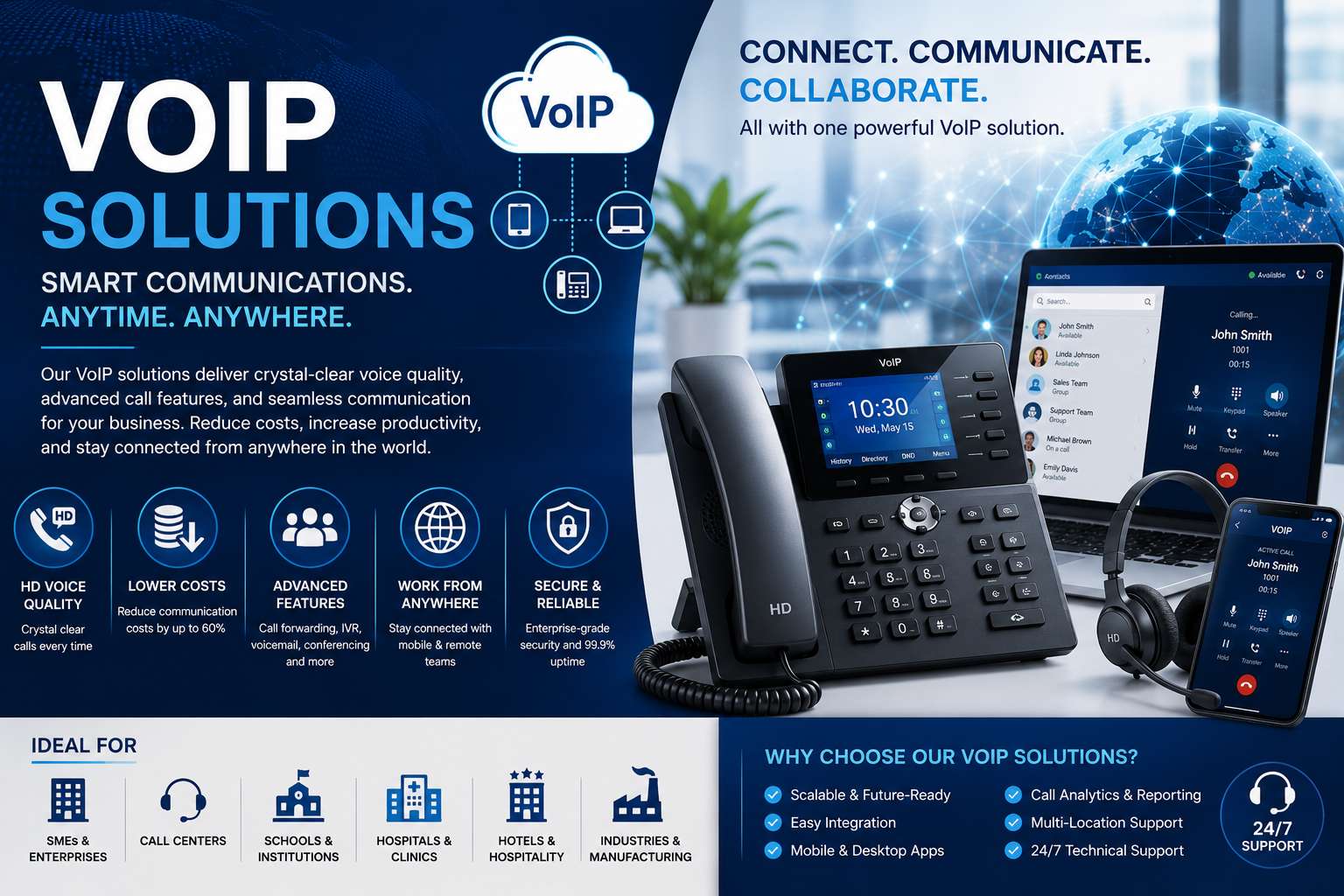
IP PHONE
Voice over Internet Protocol (VoIP, Voice over IP) is a general term for a family of methodologies, communication protocols and transmission technologies for delivery of voice communications, and multimedia sessions over Internet Protocol (IP) networks, such as the Internet. Other terms frequently encountered and synonymous with VoIP are IP telephony, Internet telephony, voice over broadband (VoBB), broadband telephony, and broadband phone. Internet telephony refers to communications services - voice, facsimile, and/or voice-messaging applications - that are transported via the Internet, rather than the public switched telephone network (PSTN). The basic steps involved in originating an Internet telephone call are conversion of the analog voice signal to digital format and compression/translation of the signal into Internet protocol (IP) packets for transmission over the Internet; the process is reversed at the receiving end. VoIP systems employ session control protocols to control the set-up and tear-down of calls as well as audio codec which encode speech allowing transmission over an IP network as digital audio via an audio stream. Codec use is varied between different implementations of VoIP (and often a range of codec are used); some implementations rely on narrowband and compressed speech, while others support high fidelity stereo codec.
Corporate Use Because of the bandwidth efficiency and low costs that VoIP technology can provide, businesses are gradually beginning to migrate from traditional copper-wire telephone systems to VoIP systems to reduce their monthly phone costs. VoIP solutions aimed at businesses have evolved into “unified communications” services that treat all communications-phone calls, faxes, voice mail, e-mail, Web conferences and more-as discrete units that can all be delivered via any means and to any handset, including cell phones. Two kinds of competitors are competing in this space: one set is focused on VoIP for medium to large enterprises, while another is targeting the small-to-medium business (SMB) market.
Cost Effective VoIP runs both voice and data communications over a single network, which can significantly reduce infrastructure costs. The prices of extensions on VoIP are lower than for PBXs and key systems. VoIP switches run on commodity hardware, such as PCs or Linux systems. Rather than closed architectures, these devices rely on standard interfaces. VoIP devices have simple, intuitive user interfaces, so users can often make simple system configuration changes. Dual-mode cell phones enable users to continue their conversations as they move between an outside cellular service and an internal Wi-Fi network, so that it is no longer necessary to carry both a desktop phone and a cell phone. Maintenance becomes simpler as there are fewer devices to oversee.